 Getty Images
US President Donald Trump's dramatic description of "very strong talks" with Iran suggested the door to diplomacy has been flung open for what he said could be "a complete and total resolution of our hostilities in the Middle East".
But Iran almost immediately denied that talks had begun - and so far, there are only signs of small windows being opened - by a crack.
One is the same window that was shattered during previous rounds of diplomacy, in February and in June last year, by US-backed Israeli attacks on Iran which destroyed the little trust that existed.
There's said to be some communication between the two lead negotiators in previous discussions - Iranian Foreign Minister Abbas Araghchi and US envoy Steve Witkoff. But these conversations are described as very preliminary.
And Tehran now sees the Witkoff track as subterfuge.
"The statements of the US president are part of efforts to reduce energy prices and buy time for the implementation of his military plans," was the retort of Iran's foreign ministry.
It's a sentiment shared by other observers too, who see a US commander-in-chief under mounting pressure to lower oil prices, lift stocks, and project progress in ending this perilous conflagration causing economic shock the world over - including in America.
And Trump is also still looking for the kind of door which opened in Venezuela, with an Iranian version of the new interim President Delcy Rodríguez - a powerful but pragmatic leader whom he can try to bend to his will.
In the early days of this war, he described Venezuela as "the perfect scenario" for Iran.
It betrayed a misunderstanding of the fundamental differences between Venezuela and Iran's multi-layered system honed and hardened over nearly five decades to ensure its survival by sidelining reformists and repressing dissent.
 Reuters
But Trump now says they're dealing with a "top person" in the Islamic Republic.
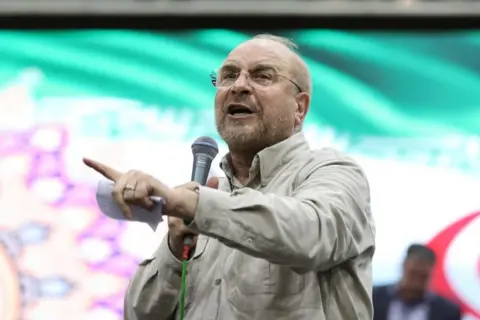
The unnamed individual being widely cited, after first reports in Israeli media, is Mohammad-Bagher Ghalibaf.
He's played leading roles in the machinery of Iran including police chief, commander of the air force in the Islamic Revolutionary Guard Corps (IRGC), as well as speaker of the parliament.
He failed four times in presidential runs and described Iranians who took to the streets nationwide in February calling for change as "enemies and terrorists."
But in Trump's world, Ghalibaf is a strongman who could possibly bridge the divides between Iran's security and political establishments.
Sources say there have been indirect efforts to try to open a dialogue with Ghalibaf but there's still no official or public sign they've yielded any success.
For Iran, it's still highly risky since Israel has been assassinating one top official after another, including Ali Larijani, the hardline security chief who knew the system inside out. He was viewed as a possible intermediary if serious negotiations were ever started.
Ghalibaf has also been entrenched among its most hardcore elements who now dominate decision-making. Since Larijani's assassination, he's now being eyed with interest as someone who might someday do a deal.
"He's the last man standing who's seen as more ideologically flexible," said one source with knowledge of the various mediation efforts. "But even Trump said if he named him, they'd kill him, and then Israel immediately named him."
"This is the most interesting track to watch," said Ellie Geranmayeh, senior policy fellow at the European Council on Foreign Relations.
But it is not clear if there has been any movement along it.
"Neither side would meet at that level until the US and Iran are nearing a political breakthrough and a lot of negotiations are needed before they even reach that stage," Geranmayeh added.
So far, Ghalibaf has become a troller-in-chief, taking on Trump's own stream of statements on social media.
"Our people demand the complete and humiliating punishment of the aggressors," Ghalibaf lashed out in a post on X on Monday. "No negotiations with America have taken place."
With the two sides wide apart, and at war, and with leading officials like Ghalibaf focused on their own survival as well as the system's, a meeting would be a bold leap.
For the moment, most diplomacy resides in working the phones. Proposals, multiple points long, are being mooted by mediators racing to find a way out of this deepening quagmire.
This time, new countries are engaging in this age-old crisis including Pakistan, Egypt, and Turkey which have not been on the front lines of the war itself. Their leaders have cultivated close personal ties with Trump and they've been actively engaged in an expanded forum of Arab-Islamic nations.
Oman, the traditional mediator most trusted by Tehran, also says it's involved in efforts to reduce tension, and reopen the vital Strait of Hormuz.
 EPA
EPABut most Arab Gulf leaders, furious over what they've described as Iran's "reckless" attacks on their countries' infrastructure, are more focused on reassessing this relationship. "It will take decades to repair this rupture," one senior official in the Gulf told me.
Pakistan, whose military and political leaders have cosied up to Trump, offered a way to climb down from his dangerous brink after the threat to strike Iran's energy infrastructure, by offering to host high-level talks as soon as this weekend.
An interesting sidebar was the recent statement by Iran's new Supreme Leader Mojtaba Khamenei in which he singled out Pakistan as being beloved by his father, the former leader assassinated in the first hours of this war.
But there's still no confirmation of any kind of meeting.
"There are no talks at this moment," said Ali Vaez of the International Crisis Group, referring to the messages being passed between Washington and Tehran as efforts "to jump start ceasefire negotiations."
"But I doubt they are anywhere close to creating enough common ground for a serious meeting or substantive talks," he cautioned.
And, as this war grinds on, Iran is making it clear that it wants to exact a heavy price. It's published a list of demands - impossible for Washington to accept - ranging from the closure of US bases in the region, to reparations, and firm guarantees against any future aggression.
Demands have also hardened on the other side. Arab Gulf states will now insist that Iran's ballistic missiles need to be on the table as well as controls over the Strait of Hormuz which has been weaponised by Iran in this war.
And then there is the deep gulf in understanding and trust which leads many to be sceptical.
Trump likely believes this war has granted him additional leverage to get Iran to accept his conditions, and Iran senses it has not only fortified its position but has additional bargaining chips in the Strait of Hormuz," remarked Mohammad Ali Shabani, editor of Amwaj.media website.
In his post announcing the talks, Trump said he was postponing his threat to strike Iran's power plants for five days - meaning all eyes are on his new deadline - Friday, when the markets close.