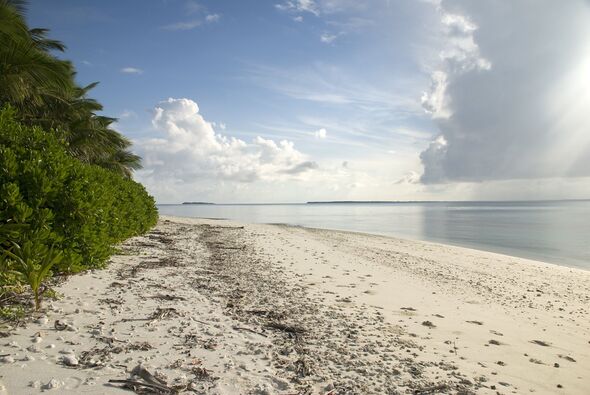

Three migrants stranded in the Chagos Islands have been relocated to Britain and have won an immigration case. The asylum seekers were all rescued by British authorities after they became stranded in the Chagos Islands, the asylum court heard. They were initially taken to Diego Garcia, a joint UK–US military base in the Chagos Archipelago, where they were put in tents alongside other migrants before later being relocated to an asylum seeker hotel in West Sussex.
Now, they have won an Upper Tribunal case after an immigration judge ruled they wrongly had their access to public funds in the UK cut off. Two of the migrants have been granted asylum while the third is still awaiting a decision.
READ MORE: Trump 'reaches agreement' with Starmer over Chagos
READ MORE: Keir Starmer scrambles as he issues major Iran update

The court heard that all three migrants initially received Universal Credit for their first six months in the UK, putting them “in a considerably better financial position than the vast majority of asylum seekers.”
However, the Home Office later cut off their access to these funds without considering their circumstances and is now required to pay the migrants’ legal costs.
The Home Office told the Upper Tribunal of the Immigration and Asylum Chamber in London that it was applying a condition attached to the migrants' leave to remain in stopping the migrants' access to public funds.
The migrants, all of Tamil ethnicity and unrelated to each other, faced severe hardships before reaching the UK. The first migrant is a Sri Lankan man in his late 30s, the second is a man in his mid twenties and the third is a woman in her late 30s.
The tribunal heard the first migrant was abused by authorities in Sri Lanka.
It was heard: "In April 2022, he and others left Sri Lanka on a boat which they believed to be bound for New Zealand.
"The vessel broke down and they were stranded on a desert island.
"They were discovered by a patrol vessel from the [BIOT] and taken to the island of Diego Garcia.
"He arrived on the island on 20 April 2022 and he remained there until he was relocated to the United Kingdom in December 2024."
The second migrant was born in a refugee camp in India, and he said he was subjected to abuse, torture and rape by the Indian authorities because of his family's support for a political group there.
In September 2021, he was one of 90 people who boarded a boat which was believed to be bound for Canada. The boat became unseaworthy and sailed towards the nearest land, which was BIOT.
It was found by a Royal Navy vessel and taken to Diego Garcia. He was medically evacuated to Rwanda in 2023, and this is where he was returned to the UK from in December 2024.
Diego Garcia is part of the Chagos Islands, or British Indian Ocean Territory (BIOT). It is a military facility used by the governments of the UK and the US for defence purposes. Diego Garcia is the largest of the Chagos Islands. The Chagos Islands have been at the centre of long-standing disputes over sovereignty and human rights.
The third migrant was born in Sri Lanka but was raised in a refugee camp in India. She has two children, now 14 and 9, with her husband. The family left India because her husband was badly treated by the authorities, as he was associated with a political group.
They were on board the same boat as the second migrant when they were rescued by the British Navy. The Supreme Court found in 2024 that 'all of the individuals who were held in the camp, including 16 children, had been detained, and that their detention had been unlawful throughout'. It found that the migrants "had been falsely imprisoned in inhumane conditions for a lengthy period".
The Home Secretary granted leave outside the Immigration Rules to all three migrants for a period of six months, in which they had access to public funds.
Upon arrival in the UK, the migrants were accommodated at a hotel in West Sussex, along with 61 others from Diego Garcia.
Ensure our latest news headlines always appear at the top of your Google Search by making us a Preferred Source. Click here to activate or add us as Preferred Source in your Google search settings.
The first migrant stayed there until May 2025 - he said he was happy, and he received Universal Credit which meant he was "able to afford clothes and shoes and to have a haircut".
The second migrant was moved from the hotel to private accommodation in January 2025, and received Universal Credit from the following month, which meant he was able to cook for himself, buy cleaning products and top up his phone.
The third migrant's family found living at the hotel very difficult as they all lived in a single room, and they were relocated to private accommodation at the same time as the second migrant.
They received Universal Credit, which allowed them to cook for themselves and buy things for the children, who started going to a school in West Sussex. All three in the tribunal claimed asylum 'well before the expiry of their six months’ leave to remain'.
They stopped receiving Universal Credit after May 2025, and this led to the first migrant becoming 'lonely, depressed, anxious and penniless', and the second migrant's mental health deteriorated to the point he contacted the Samaritans.
The first and second migrants were granted asylum in September 2025. The third migrant's family was moved back into a single hotel room in May 2025. The family was then moved to Essex in October 2025 despite the third migrant's concerns about leaving behind connections they had made in West Sussex.
The family is yet to be granted asylum in the UK. Upper Tribunal Judges Vinesh Mandalia and Mark Blundell found that the decision to stop the migrants' access to public funds was invalid because of legal errors.
The Home Office had not taken the migrants' circumstances into account, the judges found, and failed to give them an opportunity to make representations when it stopped their entitlement to public funds.
The judges said: "Their circumstances were highly unusual when they arrived in December 2024, but they were all the more unusual in May 2025, by which stage they had had access to public funds for several months and had benefited in various ways from that allowance.
"They had been in a considerably better financial position than the vast majority of asylum seekers in the UK and the decision to place them in the same position as other asylum seekers would necessarily have real human consequences which the respondent was obliged to consider."
The migrants' ability to access public funds, particularly Universal Credit, had 'finally brought some stability to their lives', the judges said.
The Home Office has been refused permission to appeal the decision.
The migrants' claims for damages will be assessed by a tribunal at a later date.