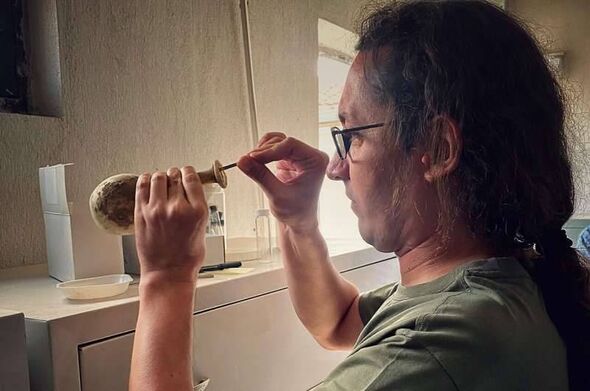

Archaeologists have discovered that ancient Romans utilised human excrement as a remedy for common health issues. Following the analysis of a 2,000-year-old glass vial, it's now certain that human faeces were indeed part of the ancient medical arsenal.
The Romans are thought to have used it to combat infections and inflammation, a practice also documented in ancient Egyptian, Chinese, and Greek texts. This latest study provides the first tangible evidence supporting the notion that they believed faeces could cure ailments, reports the Daily Star.
Scientists examined the brown remnants inside the vial and found traces of human waste and thyme, likely used to disguise the unpleasant odour. The vial was unearthed in a tomb in Pergamon, an ancient city in present-day Turkey that was remodelled by the Roman emperor Trajan in the early second century.
Pergamon was also home to the esteemed physician Galen of Pergamon, who is considered one of the most prominent physicians of antiquity alongside Hippocrates.
"Faecal-based pharmacological treatments are widely attested in Greco-Roman medical texts," said lead author Dr Cenker Atila, of Turkey's Sivas Cumhuriyet University.
"The use of faeces as a form of treatment was known in the ancient Egyptian, Chinese, Greek, and Roman worlds, based on written sources."
"However, until now, there had been no archaeological evidence of this practice. The vessel's contents revealed a distinctive blend of human faecal biomarkers.
"And aromatic compounds such as carvacrol, a major constituent of thyme oil. These results align with classical prescriptions that combined dung with odour-masking agents to enhance patient compliance."
Researchers are now examining additional vials and ceramic vessels held in museums throughout Turkey to determine whether other ancient pharmaceutical specimens have survived.
Should further discoveries emerge, we may be approaching a fascinatingly grotesque reassessment of Roman medical practices - complete with herb-infused excrement remedies that have been concealed in collections for centuries.
Contemporary medicine has, mercifully, progressed considerably - though present-day faecal microbiota transplants (administered professionally in clinical settings for severe intestinal infections) demonstrate that, generations later, the notion that gut-derived substances can aid healing isn't entirely without merit.
The Romans, it appears, had grasped something significant, albeit employing a considerably less appetising method of administration.